



Image Gallery
Solar Empowerment: The Compass of Biological Truth
The sun has been the governing force of life on Earth since the first cells emerged in the primordial oceans roughly 3.5 billion years ago. This alignment is the very foundation of biological existence—and it is also the foundation of the Solar Empowerment system.
The Suprachiasmatic Nucleus (SCN): The Master Conductor
The Suprachiasmatic Nucleus (SCN) is the master conductor of your body’s internal symphony. It doesn't just 'keep time'—it triggers a high-precision chain reaction at the molecular level. From the moment specific light frequencies hit your eyes, the SCN coordinates everything from how your genes behave to how your hormones shift and how your cells repair themselves. It is the primal biological clock within our brain that dictates our internal rhythm based on the sun’s precise angle relative to where we stand.
The Modern Disconnect
Today, we live in an era of 'biological silence'. In a tiny fraction of evolutionary time, modern life—with its artificial lights, rigid work schedules, and constant travel—has tried to override this deep biological wisdom. Most platforms lead you to believe that generic advice or 'hacks' can somehow override your fundamental nature. This creates a state of constant 'social jetlag', where your internal chemistry is constantly at war with the clock on the wall.
Ultimately, the modern human exists in a state of constant physiological friction, living out of sync with the environment our biology was built to navigate.
The Physics of the Sun Meets the Chemistry of the Brain
While other systems attempt to change your biology with trackers or wearables - essentially forcing you through the physiological friction - Solar Empowerment aims to remove the friction completely.
Solar Empowerment strips away the noise of the modern 'wellness' trends and focuses on the fundamental math of existence: the relationship between light and life. Because every cell in your body evolved to respond to a world that changes with the sun every day, static schedules are no longer enough. Solar Empowerment uses your GPS location to calculate the exact solar phases for a more dynamically changing schedule.
Evolution: The Master Architect
Evolution has been the master architect of your biology for billions of years, and it has already optimized you for peak performance. Long before humans existed, life developed the SCN as a foundational system closely linked to the sun’s rise and fall. Therefore, we don't ask you to 'hack' your body; we ask you to understand and lean into your evolution. Health and high performance aren't things you manufacture; they are things you reclaim by leaning into this ancient alignment.
Main Screen
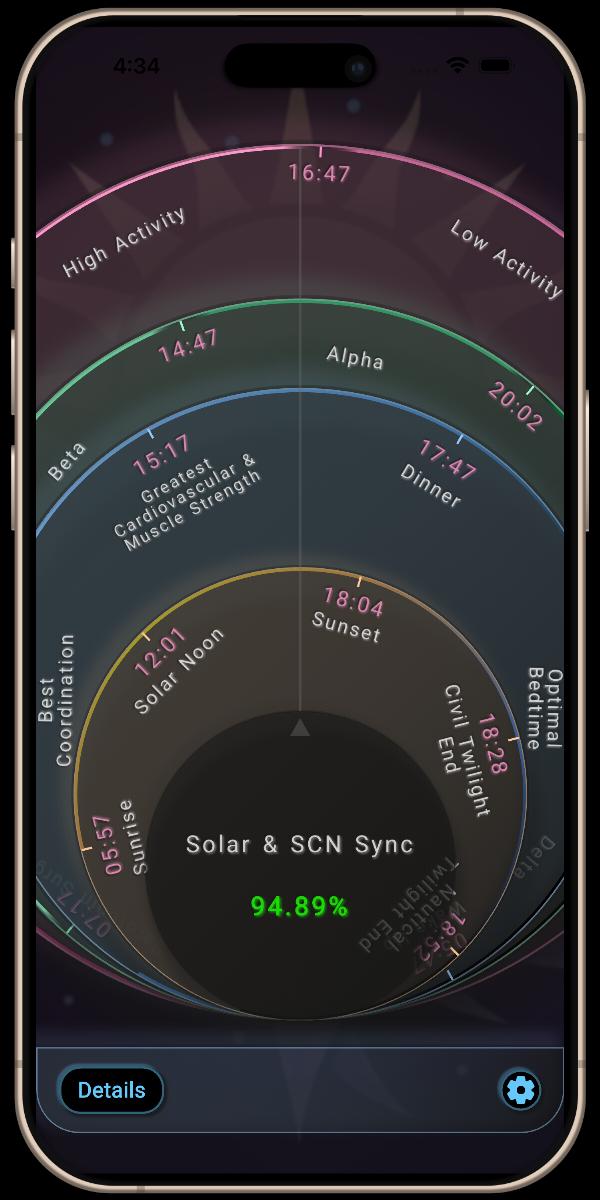
The main screen of Solar Empowerment provides the essential data you need for the present moment. Presented in intuitive rotating rings, your Neuro-Biological data is organized into five key categories for seamless reference:
- The daily average Solar & SCN Sync
- The Current Solar Milestones
- The Current Meal & Physiological Milestones
- The Current Brain States
- The Current SCN Phases
For more details of all the Milestones and Phases for the day, simply click on the 'Details' button.
Solar & SCN Sync
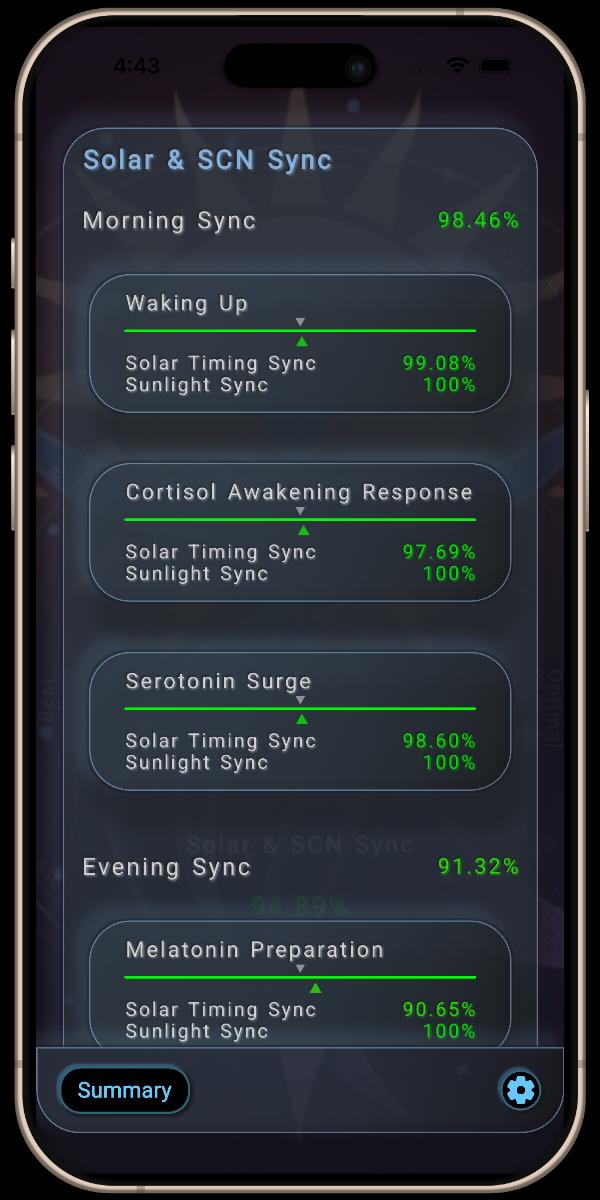
This section provides a detailed breakdown of the day's Solar & SCN Sync, showing the synchronization averages for the morning and evening, as well as their key SCN phases:
Morning Sync
- Waking Up
- Cortisol Awakening Response
- Serotonin Surge
Evening Sync
- Melatonin Preparation
- Go To Sleep Window
For a clearer understanding of the Solar & SCN sync, each key SCN phase displays details for two important variables:
Solar Timing Sync
This reflects the alignment between the optimal solar window and the actual period of the internal SCN phase. The '▲' icon acts as a clear indicator of how far the phase is out of sync, and whether it occurs earlier or later than the optimal time.
Sunlight Sync
This reflects the degree to which the required environmental sunlight levels were met during the duration of the SCN phase. The visual bar is a clear indicator of how much optimal sunlight is available, and whether it is available at the start or the end of the phase.
Sleep & Wake Timings
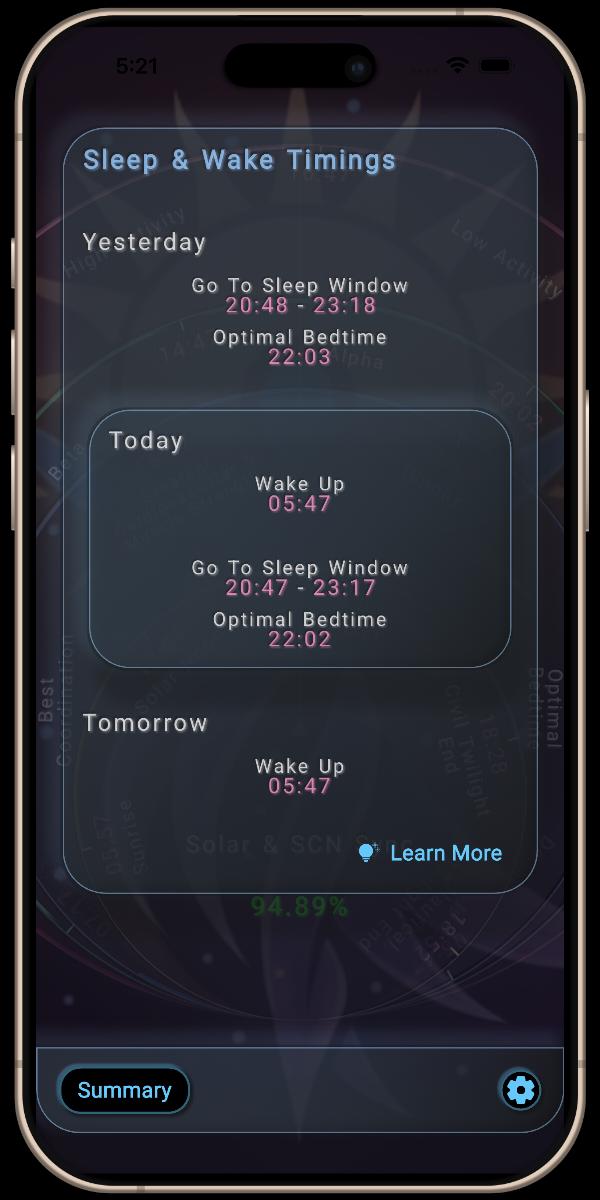
This section serves as a clear reference for viewing your key sleep and wake timings:
- Wake Up Time
- Go To Sleep Window
- Optimal Bedtime
For additional context, this includes the Go to Sleep timings from the day before, as well as the Wake Up time for the day after.
Understanding Sleep
Sleep isn't just 'turning off'; it is a complex, 24-hour biological recycling process. Your habits throughout the day directly dictate the quality of your sleep at night.
How many hours of sleep do humans need?
Although modern consensus suggests 7–9 hours, primal humans often thrived on less. Anthropological studies of hunter-gatherer societies (like the Hadza or San people) show they average closer to 5.7 to 7.1 hours of actual sleep.
The reason we are told to sleep longer today is that our quality of sleep has plummeted. Between artificial blue light, caffeine, and 'Social Jetlag' (staying up late on weekends), the modern human spends hours in 'shallow' sleep stages. We have been forced to extend our time in bed to compensate for how inefficient our sleep has become. We aren't sleeping more because we need it; we're sleeping more because our 'sleep-per-hour' recovery rate is at an all-time low.
To understand why quality matters more than quantity, we must look at the three main chemicals governing your rest: Serotonin, Melatonin, and Adenosine.
Serotonin
During the day, sunlight hitting your eyes triggers the production of Serotonin. This is your 'active' hormone — it keeps you alert, stabilizes your mood, and acts as the essential raw material for your sleep.
Melatonin
When triggered by your internal clock (the SCN), your brain takes its stored Serotonin and transforms it into Melatonin. This is your 'sleep signal' hormone — it lowers your body temperature, slows your metabolism, and acts as the key that unlocks your internal sleep gate.
Adenosine
While you are awake, your brain creates a byproduct called Adenosine. Think of it as the 'exhaust' from your brain’s engine. Every time you think, move, or create, you burn energy (ATP). Adenosine is the 'spent fuel' left behind.
The buildup of this 'sleep pressure' chemical causes increasing grogginess and a loss of focus. Sleep is the active evacuation of this chemical.
3 Chemical Summary
From the connection between these 3 chemicals, you now understand a few habits linked to sleep:
- More Serotonin = More Melatonin - The more sunlight you get during the day, the better your sleep will be at night.
- More Activity = More Adenosine - The more mental or physical activity you complete, the more 'exhaust' you create, leading to faster sleep onset and deeper recovery.
Waking Up Early (Fully Rested)
If you wake up naturally before your optimal time and feel refreshed, stay awake. Your Adenosine has been cleared, and you have completed a healthy sleep cycle. You are in the rare and sought-after state of 'High Alpha' - a flow state of peak creativity and deep focus.
Waking Up Early (Still Exhausted)
Sadly, this is how most people wake up, forced by alarms or disturbances. That heavy groggy feeling, called 'sleep inertia,' occurs because Adenosine is still present in your system. This leftover Adenosine will compound with the new 'exhaust' created today, dragging down your focus and mood until your next sleep.
Waking Up Late
This is another common state of modern life. You may feel rested because you've had enough sleep to flush out your Adenosine, but your internal clock (SCN) is in constant disagreement because you missed the morning light cues. You are spending valuable energy fighting your natural rhythm. You are working harder just to stay level.
Solar Milestones
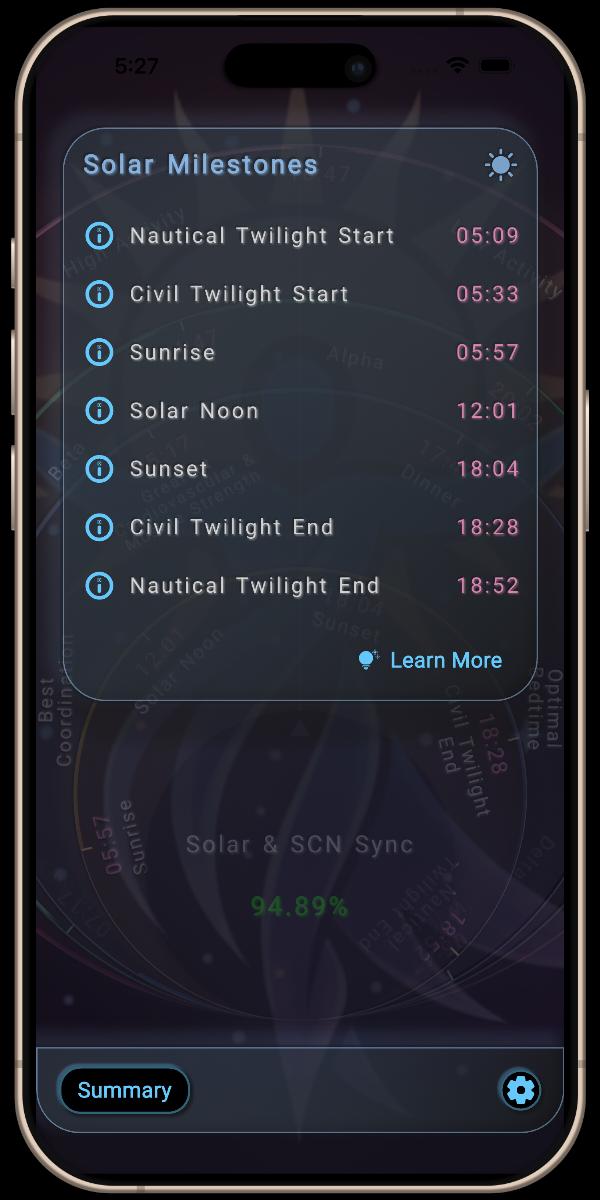
Nautical Twilight Start
This is when the first faint hints of light start to reach the upper sky. While it’s still dark on the ground, the horizon turns a deep indigo, letting you see the dark shapes of trees or hills against the sky. It’s the exact moment the world stops being pitch black and starts to show its first silhouettes.
Civil Twilight Start
The light is now strong enough that you can start to see colors and details on the ground without needing a flashlight. The sky shifts from deep blue to a much brighter tone as the sun gets closer to the horizon. It’s that clear, early-morning light where the world finally feels fully visible.
Sunrise
This is the moment the top of the sun finally peeks over the horizon. The soft, scattered blue light of the morning is suddenly replaced by direct, warm rays of sunshine. It marks the shift from a dim glow to the first real heat and brightness of the day.
Solar Noon
The sun has reached its highest point in the sky for the day. Because it's directly overhead, the light is at its most intense and shadows are at their shortest. It is the peak of the day's brightness, with the sun's energy hitting the ground most directly.
Sunset
This is when the last bit of the sun disappears below the horizon. The direct, bright white light fades away, often leaving behind a glow of reds and oranges in the sky. The air starts to feel dimmer almost immediately as the world moves from direct sunlight back into shadows.
Civil Twilight End
The light has faded enough that it becomes hard to see small details or colors clearly without help. There is still a lingering glow on the horizon, but the ground is quickly becoming dark. It’s that 'in-between' time just before the world settles into true night.
Nautical Twilight End
The horizon finally vanishes as the last bit of blue light disappears from the sky. At this point, the sky and the ground both look like a single dark void, and only the brightest stars are visible. It’s the moment the world officially enters total darkness.
Meal Milestones
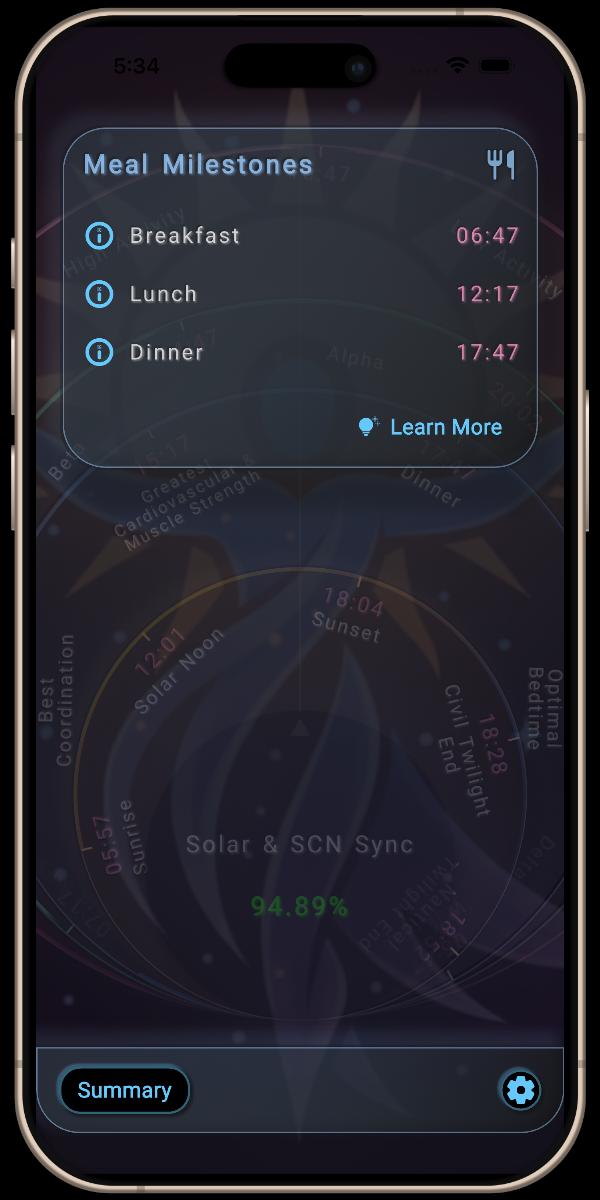
Breakfast
This meal is timed to coordinate with the body’s natural morning energy surge. Eating at this point provides fuel just as the metabolism is revving up and insulin sensitivity is at its peak. It helps lock in the internal rhythm for the day and ensures the body uses that energy efficiently rather than storing it.
Lunch
This serves as a midday refueling point to maintain steady energy levels. It is designed to provide a consistent supply of nutrients to keep blood sugar stable and prevent a late-afternoon crash. Staying consistent with this timing helps keep the metabolic engine running smoothly and supports sustained focus through the second half of the day.
Dinner
This is the final refueling point of the day, timed to provide enough resources for evening tasks without overworking the digestive system too late. Eating at this time allows the metabolism to process nutrients while the body is still active. This ensures that during the transition toward rest, the system can focus entirely on recovery instead of digestion.
Physiological Milestones
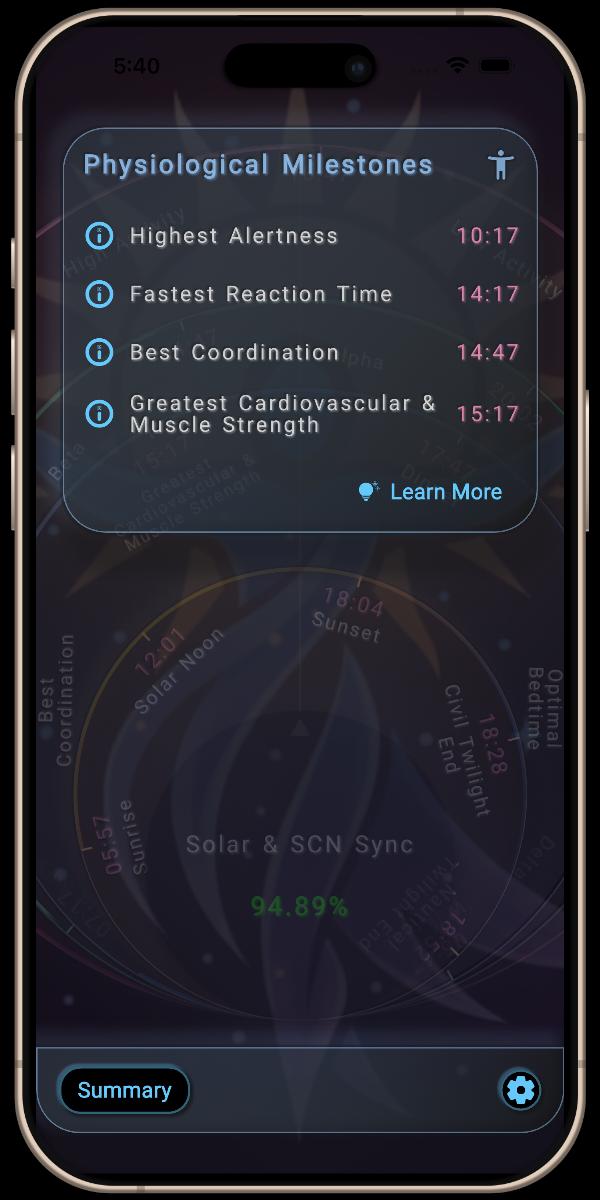
Highest Alertness
Peak mental sharpness for the day is reached during this window. It is the time when the brain is best at processing complex information, solving problems, and staying focused on demanding tasks without getting easily distracted. If there is a big decision to make or a difficult project to finish, this is when the mind is most 'switched on.'
This state occurs once the system has moved through its various morning chemical surges and reached a state of equilibrium. With primary daytime hormones and neurotransmitters now fully stabilized and circulating at their optimal levels, mental 'bandwidth' is at its maximum capacity. The brain is essentially functioning at its most efficient cruising altitude, free from the fluctuations of the earlier morning transitions.
Fastest Reaction Time
Physical response speed reaches its daily peak during this window. It identifies the ideal time for activities that require split-second decisions and rapid movements, like navigating heavy traffic or engaging in fast-paced sports. This is when your reflexes are at their most acute and your ability to react to sudden changes is at its fastest.
This physical speed comes from a high state of arousal in the central nervous system. At this point in the cycle, the communication between the brain and the muscles is at its most streamlined, allowing signals to travel with minimal interference. The sensory systems are operating at their highest velocity, leaving the body primed for instant, sharp action.
Best Coordination
The harmony between the brain and the body is at its most stable during this period. The primary focus here is on balance, timing, and fine motor skills—the ability to perform complex or precise movements that require more control than raw speed. It is the best time for tasks that require a steady hand or perfect rhythm, from technical craftwork to playing a musical instrument.
At this point, the body’s internal sensors are providing the most accurate feedback to the brain. With core temperature and energy levels holding steady, the parts of the brain that control balance and movement are in their most consistent state. This allows for smoother and more accurate control over the muscles, making the body feel completely 'in sync.'
Greatest Cardiovascular & Muscle Strength
Physical power and endurance reach their daily peak during this window. This represents the time when the muscles can exert the most force and the heart and lungs can handle the highest intensity. For anyone looking to push their physical limits or handle heavy manual tasks, the body is naturally most capable of managing that stress at this time.
This capacity is driven by the increased flexibility and resilience of the muscle fibers, which are now at their most responsive. Blood vessels are also more dilated at this stage, significantly improving the delivery of oxygen and nutrients to the tissues. It creates an ideal internal environment for high-output activity, allowing for more power and stamina with less perceived effort.
SCN Phases
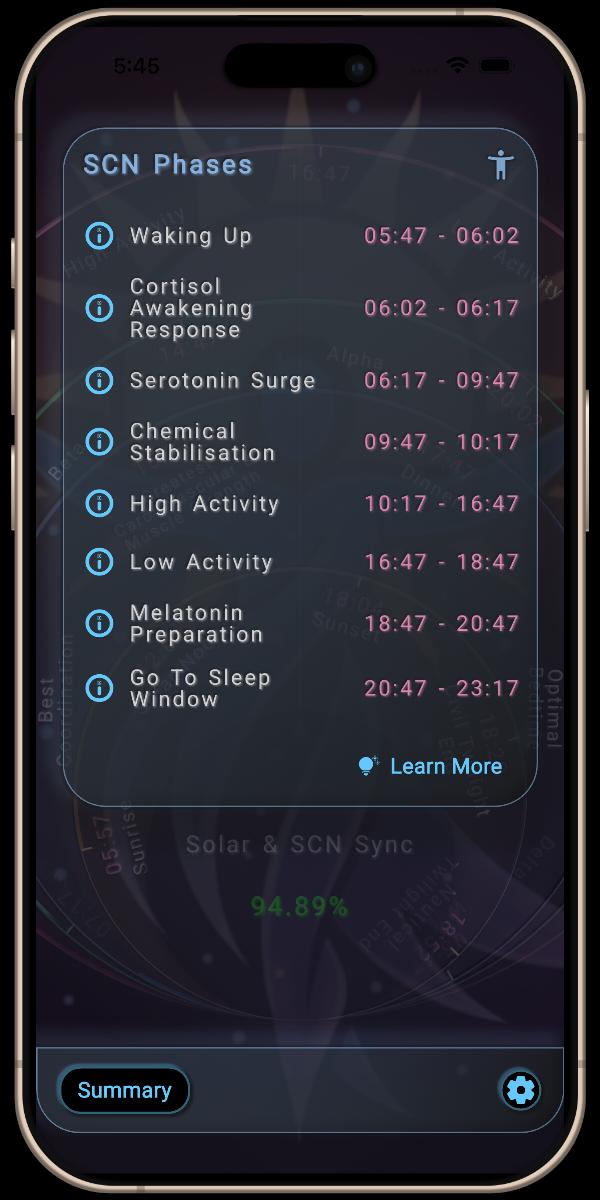
Waking Up
The 'Wake Up' phase is the moment your internal clock begins the smooth transition from deep restoration to daytime alertness. It is much more than just opening your eyes; it’s a coordinated 'power-on' sequence for your entire system. During this window, your brain begins to pull back the hormones that kept you asleep, while quietly priming your body for the energy it will need for the hours ahead.
This phase acts as the ignition for your metabolic engine. By waking up in alignment with this specific trigger, you ensure that you are rising with your biology rather than forcing it into consciousness. When you time your morning to this natural shift, you avoid that heavy, groggy feeling—known as sleep inertia—that usually comes from being jolted out of a deep repair cycle at the wrong time.
Instead of a sudden shock to the system, this transition allows for a seamless flow into your first morning activities. It sets the foundation for your hormonal balance for the rest of the day, ensuring you start with a clear head and a steady supply of energy. It’s about working with your body’s natural momentum from the very first minute you’re awake.
Cortisol Awakening Response
This phase acts as your body’s natural shot of espresso. Right after you wake up, your system releases a sharp, intentional wave of cortisol to sharpen your senses and provide the initial burst of fuel needed to get moving. It serves as the bridge between the quiet dawn of waking up and the active energy of the day ahead.
The pace of this surge is heavily influenced by light. When your eyes detect the morning brightness, it signals your internal clock to coordinate this chemical release. This 'light-trigger' is what essentially sets the tempo for your entire day. It isn’t just about alertness; it’s a full-system alert that helps regulate your blood pressure and blood sugar levels after a night of fasting.
Because this is a high-intensity chemical shift, it’s best treated as a preparation window. Your body is doing the heavy lifting of stabilizing your internal environment and clearing out the last remnants of sleep. Navigating this surge correctly, ideally with the help of natural light, ensures your energy levels stay consistent throughout the morning, preventing a premature crash before you even reach your first major milestone.
Serotonin Surge
After the high-energy rush of cortisol, your body moves into a more balanced and 'good-vibe' phase driven by serotonin. This is the moment where the initial intensity of waking up transitions into a sense of calm, steady well-being. It’s like the system is smoothing out the edges of that first morning spark, replacing raw urgency with a more refined, positive focus.
This phase is heavily powered by the presence of bright light. When you expose yourself to morning brightness, it signals your brain to maximize serotonin production. This is so vital to our mental health that it is the primary way we prevent seasonal mood slumps; essentially, light acts as a natural fuel for your mood, keeping your outlook bright and your social motivation high.
Interestingly, this surge is also a critical precursor for the end of your day. The serotonin your body produces and stabilizes during this window is the very same building block used to create melatonin later tonight. By prioritizing bright light during this surge, you aren't just improving your morning—you are essentially 'pre-ordering' a better night's sleep.
Chemical Stabilisation
This is the phase where your body’s internal chemistry moves from 'startup mode' into 'steady state.' Think of it as the moment a plane reaches its cruising altitude; the engines are still working hard, but the turbulence of the climb is over. Your morning hormones have finished their initial surges, and your system is now focused on maintaining a perfectly balanced environment for your brain and body to thrive.
At this point, the primary 'daytime' signals in your brain have reached a consistent level. Your metabolism is fully online, your body temperature is stable, and the various neuro-chemicals responsible for focus and mood are working in harmony. This internal equilibrium is what allows you to transition out of the 'waking up' process and into the high-performance windows that follow, like your peak alertness and coordination.
By respecting this stabilization window, you allow your body to finish its internal housekeeping without distraction. It is the final preparation step that ensures your energy remains sustainable for the long haul. When this phase is complete, your biology is no longer reacting to the transition of the morning—it is officially 'ready for business', providing you with the most reliable and consistent version of yourself.
High Activity
This window represents the period when your body is most resilient and capable of handling heavy demands. With the morning transitions complete, your system enters a high-performance 'flow state' where physical and mental resources are fully synchronized. It is the time of day when your internal engines are running most efficiently, allowing you to tackle your most challenging tasks with the least amount of friction.
During this phase, your cardiovascular system is operating at peak efficiency and your nervous system is highly responsive. This isn't just a brief peak; it is a sustained plateau of capability. Your muscles are naturally more pliable and your heart rate and blood pressure have adjusted to support active movement, making it the ideal time for anything from intense creative work to high-energy physical labor.
Because your body is in its most robust state, you are also at your most 'stress-proof' during this phase. Your internal chemistry is perfectly balanced to handle the natural pressures of the day without feeling overwhelmed. It is the gold standard for productivity, providing a reliable window where your biology is doing everything it can to support your output and endurance.
Low Activity
This window marks the gentle shift from high-intensity output to a more measured, reflective pace. Your body has passed its physical and mental peaks for the day and is now beginning to conserve energy. It isn’t time to shut down quite yet, but rather a time to shift your focus toward less demanding tasks that require a steady, relaxed approach rather than raw power or intense concentration.
As your internal systems begin to throttle back, you might notice a natural 'softening' of your energy. This is a deliberate biological slowing; your heart rate and metabolic processes are starting to level off after the sustained plateau of the afternoon. While you are still fully alert, your body is no longer pushing for peak performance, making this the perfect time for administrative work, light movement, or social connection.
Respecting this phase is the key to preventing 'burnout' before the day is actually over. By acknowledging that your body is moving into a lower gear, you can avoid the frustration of trying to force high-level productivity when your biology is naturally asking for a lighter load. It serves as a vital buffer, allowing your system to coast smoothly toward the evening's rest rather than crashing into it.
Melatonin Preparation
This phase marks the beginning of your body’s evening transition, acting as the quiet backstage work required for a successful night’s rest. As the day's light begins to soften, your internal clock starts to shift its focus from external performance to internal maintenance. It is the crucial 'cool-down' period where your system begins to clear away the day's chemical leftovers and prepare the pathway for sleep hormones to take over.
During this window, your brain begins to dial down the stimulating signals that kept you alert throughout the afternoon. Your core temperature starts a slow, controlled decline, which is a key biological signal that the body is preparing to rest. This is the ideal time to start dimming the lights and narrowing your focus; by stepping away from bright screens and high-intensity blue light, you avoid sending 'daytime' signals to your brain just as it’s trying to switch gears.
The success of your upcoming sleep cycle depends heavily on how you navigate these moments. By reducing high-intensity stimuli and allowing this preparation to happen naturally, you are giving your brain the green light to begin the final hormonal shifts. It is about creating a 'landing strip' for your evening, ensuring that when the time comes to finally sleep, your body is already halfway there.
Go To Sleep Window
This is the most critical window for your recovery, representing the moment your internal clock is screaming 'now'. This is the point where melatonin levels reach a threshold that forces your brain's sleep-gate to open. It is a biological invitation to rest that, if accepted, leads to the most profound and restorative sleep possible.
While we often think we need eight hours of sleep to feel human, the quality of that sleep is dictated by this specific timing. Interestingly, our ancestors —the 'Primal Man'— often managed with less total sleep time than we do today. This wasn't because they were superhuman, but because they lived in perfect harmony with this window. Without the disruption of artificial lights and digital distractions, their transition into sleep was immediate and deep, making every hour of rest significantly more efficient than the fragmented sleep we often experience now.
Missing this window by even an hour can cause a 'second wind', where your body mistakenly thinks it needs to stay awake for an emergency, releasing a fresh hit of energy that makes falling asleep much harder later. By respecting this window and following that primal lead, you ensure that your brain enters its deep repair cycles as quickly as possible. It is the final, most important hand-off in your 24-hour cycle, where you stop doing and start recovering.
Brain States
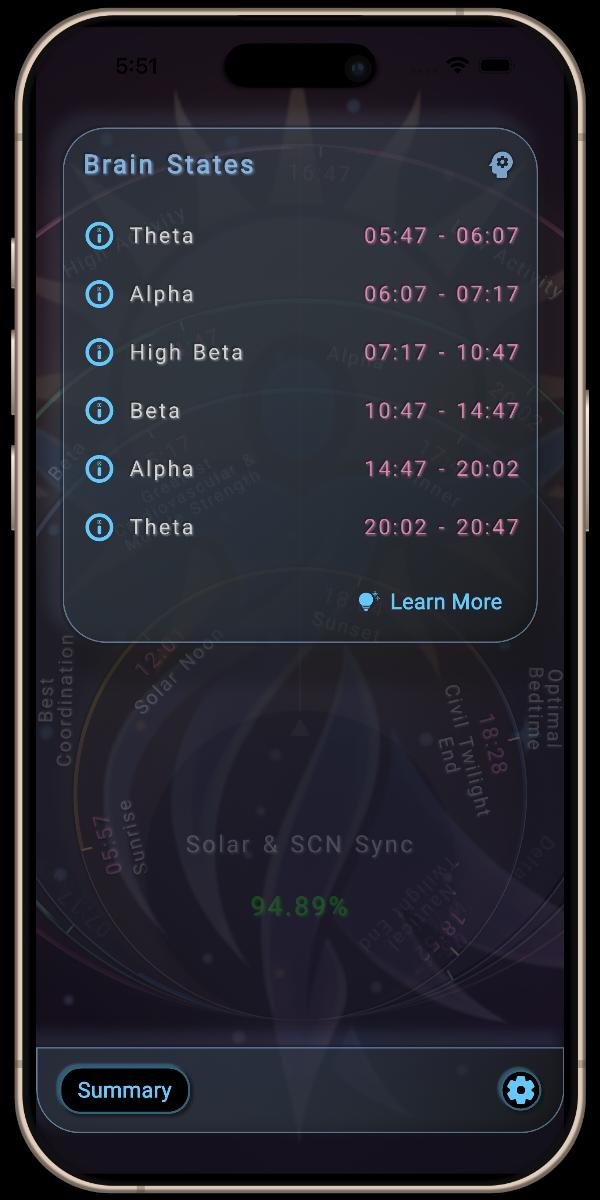
Theta
Theta is the 'twilight' state of the brain, a rhythmic frequency that occurs when you are hovering right on the edge of conscious awareness. In this window, the logical, critical part of your mind steps aside, allowing the more creative and intuitive layers to take the lead. It is a deeply relaxed state where the boundaries between your thoughts and your imagination become blurred, creating a unique mental environment that is neither fully alert nor fully submerged.
Because the mind is so receptive in this state, it is the ultimate window for 'super-learning' and creative problem-solving. This is the time when 'Aha!' moments occur—those sudden flashes of insight where complex problems seem to solve themselves without forced effort. It is also an ideal period for visualization, light meditation, or simply letting your mind wander through complex ideas. Without the noise of the outside world, your brain is free to make distant connections that you might miss during your more high-frequency, busy hours.
Regardless of whether you are transitioning into your day or winding down from it, Theta represents your brain’s most plastic and impressionable state. It is a period of profound internal focus where you can shift your perspective or simply enjoy the vivid, flowing stream of consciousness that characterizes deep relaxation. By leaning into this state rather than rushing through it, you tap into a well of mental flexibility that serves as a powerful foundation for your emotional and creative well-being.
Alpha
Alpha is the 'flow' state of the brain, characterized by a sense of relaxed alertness and effortless presence. It represents the neutral territory between your deep, internal thoughts and the high-energy analytical thinking required by the outside world. In this state, your mind is clear, calm, and ready to engage without the frantic 'chatter' of a busy ego. It is the mental equivalent of a calm lake—still on the surface, but deeply reflective and responsive.
This is the peak window for 'passive productivity' and high-level learning. When your brain is in Alpha, you are more likely to experience a sense of being 'in the zone', where tasks seem to flow naturally and your stress levels remain low despite the work at hand. It is an excellent time for brainstorming, light reading, or any task that requires a balance of focus and creativity. Because you are less reactive to external distractions, you can process information with a level of poise that is difficult to achieve during more intense periods.
Whether you are emerging into the world or retreating from it, Alpha provides the mental space necessary for clarity and composure. It is a state where your brain remains highly capable while staying deeply centered, allowing you to maintain a steady, high-quality output without burning through your mental reserves. By recognizing this state, you ensure your mind remains agile, providing a sustainable foundation for both your work and your emotional well-being.
High Beta
High Beta is the brain’s 'overdrive' state, characterized by the fastest and most intense electrical frequencies. While regular Beta is for organized focus, High Beta is where the brain goes when it needs to process a massive amount of information simultaneously or react to an immediate, high-stakes situation. It is a state of hyper-alertness, where your senses are sharpened to their absolute limit and your brain is firing on all cylinders to keep up with a rapidly changing environment.
This state is your biological 'emergency response' system for the mind. It is incredibly useful for moments that require split-second decisions, intense competition, or navigating a high-pressure deadline where every second counts. In this window, your brain prioritizes speed and survival over long-term reflection, giving you a temporary 'super-focus' that can help you blast through obstacles or handle a crisis with surprising efficiency.
Because this state consumes a significant amount of mental fuel, it is best used in short, intentional bursts. It is the mental equivalent of 'redlining' an engine; it provides incredible power, but it isn't meant for cruising. By recognizing when you are in High Beta, you can lean into that intense energy to conquer your most daunting challenges, while also remembering to transition back to a lower gear once the high-pressure moment has passed.
Beta
Beta is the 'active' state of the brain, representing the standard operating frequency for a focused, productive mind. Unlike the more relaxed flow of Alpha, Beta is characterized by a 'linear' focus, making it your primary mental workspace for logic, organization, and deliberate action. It is the state where you are fully engaged with the task at hand, providing the mental stability needed to process information and make conscious, reasoned decisions throughout the day.
This is the window for 'reliable mental execution'. In this state, your ability to concentrate on specific details is sharp, making it the ideal time for professional tasks, complex problem-solving, or any work that requires disciplined attention. It offers the 'mental grip' needed to stay on track without becoming distracted. While it is more active than Alpha, it is designed to be a sustainable level of focus, allowing you to move through your to-do list with a clear sense of direction and purpose.
Because this is an externally-oriented state, it is where you are most 'connected' to the demands of your environment. It provides the alertness necessary to navigate your responsibilities with total intent and clarity. By utilizing this state for your core daily work, you take advantage of your brain's natural capacity for organized processing, ensuring that you remain productive and effective without hitting the exhaustion of higher-stress frequencies.
Description & 12 Month Summary
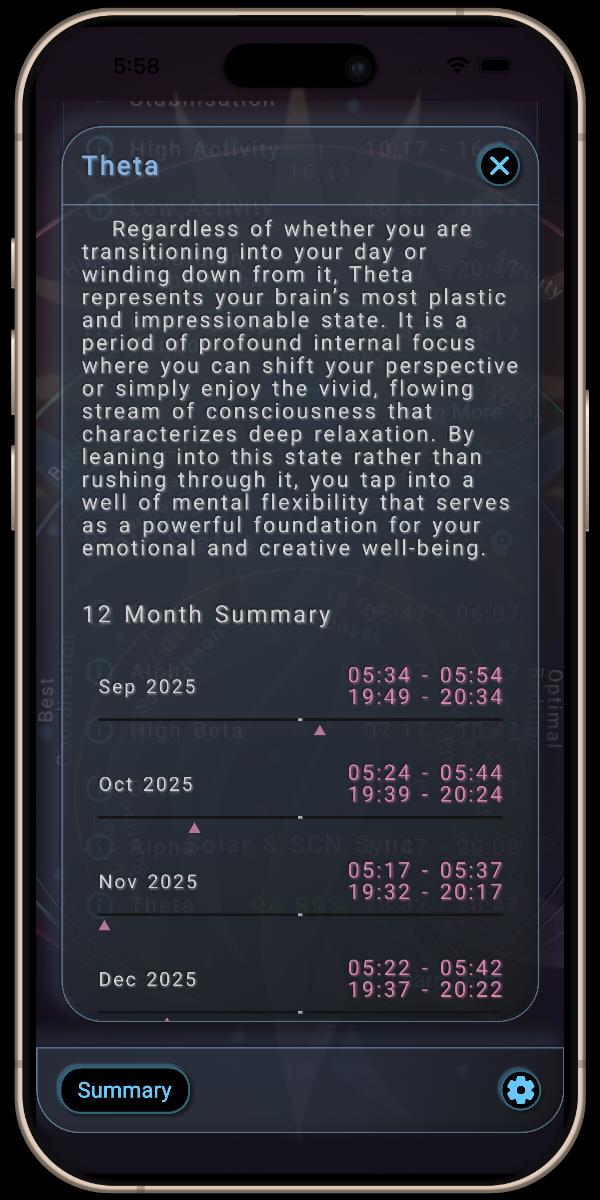
Clicking the 'ⓘ' icon for any Milestone or Phase opens a detailed view providing a brief description of that event. You are also shown a 12-month summary of the event's timings—covering the day before, the day after, as well as 5 months prior and 6 months ahead—offering a full overview of how much the timing drifts throughout the year.